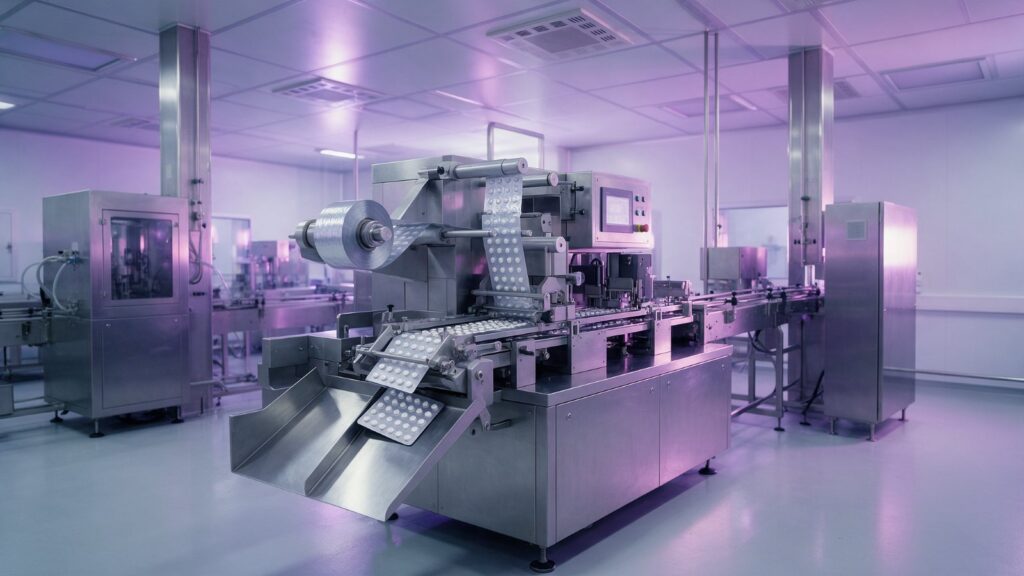

Pharmaceutical manufacturing is one of the most energy-intensive activities in the industrial landscape. Cleanrooms that never stop, air handling units running 24/7, purified water loops, steam for sterilisation, compressed air, chillers: every one of these systems consumes energy continuously, often well beyond what the process itself actually requires. As electricity and gas prices stay volatile and decarbonisation targets become part of customer audits and tenders, energy has moved from the utilities line of the budget to the agenda of plant managers and boards.
The good news is that most facilities are sitting on savings they have never quantified. The challenge is knowing where those savings are, how much they are really worth, and how to capture them without ever putting product quality at risk.
Why pharmaceutical plants consume more than they need
A pharmaceutical facility is designed around one priority: product quality and patient safety. Air change rates, pressure cascades, temperature and humidity set points are defined to protect the product, and once validated they tend to stay untouched for years. Production volumes change, layouts change, rooms change use, but the utilities keep running on the assumptions made at design stage.
Add to this the natural oversizing of HVAC systems, boilers and chillers, the safety margins applied at every step of the design, and equipment that has quietly aged past its efficiency curve, and the result is a plant that consumes considerably more energy than its current production actually demands. None of this shows up in a quality audit. It shows up in the energy bill, month after month.
Where the energy is actually lost
In most chemical-pharmaceutical and healthcare facilities, the same areas come up again and again when consumption is measured rather than estimated:
- HVAC and cleanroom air management — typically the largest single consumer. Air change rates that have never been reviewed, full operation during idle shifts, and reheating air that has just been cooled.
- Compressed air — one of the most expensive utilities per unit of useful work, and the one with the highest leakage rates. Leaks of 20% to 30% of generated volume are common in plants that have never run a dedicated campaign.
- Steam and hot water — uninsulated lines and valves, failed steam traps, and condensate that is discharged instead of recovered.
- Chillers and cooling circuits — fixed set points, poor sequencing between machines, and condensing temperatures higher than the ambient conditions would allow.
- Purified water and WFI systems — continuous circulation and thermal sanitisation cycles that are rarely optimised after qualification.
- Waste heat — thermal energy from compressors, chillers and autoclaves released into the atmosphere while the same plant is burning gas to produce heat a few metres away.
Individually these look like minor inefficiencies. Together they often account for 15% to 30% of a site’s total energy consumption, with payback periods that are far shorter than most capital projects on the plant’s investment list.
Efficiency without touching validated parameters
The most common objection in a regulated environment is that energy projects introduce risk. It is a legitimate concern, and it is also the reason why generic energy consultancy rarely works in this sector. A proposal that looks excellent on a spreadsheet becomes unusable the moment it affects a validated parameter or triggers a requalification nobody had budgeted for.
In practice, a large share of the savings available in a pharmaceutical plant sits outside the critical envelope: heat recovery, upgrades to motors, pumps and compressors, control and sequencing strategies, insulation, leak reduction, scheduling of non-critical loads. These interventions reduce consumption while the product sees exactly the same conditions as before. Work that does touch the classified environment — reviewing air change rates during unoccupied periods, for example — has to be handled with the change control process it deserves, with the risk assessment and documentation prepared from the start rather than improvised later.
Why identifying the opportunity is only the first step
Many companies already have an energy audit in a drawer. Far fewer have projects that were actually built and savings that were actually measured. The gap between the two usually opens at three points.
Technology selection. Every supplier presents its own solution as the answer. Comparing a heat pump, a cogeneration unit, a heat recovery system and a photovoltaic plant on a like-for-like basis — same assumptions, same operating hours, same energy prices — is what separates a sound investment from an expensive one.
Procurement and contracts. The same technology can differ by a significant margin in price, scope and guarantees depending on how the tender is prepared and how the negotiation is conducted. Performance guarantees in particular are often vague, and vague guarantees are impossible to enforce.
Verification. If consumption is not measured before and after the intervention, with a shared baseline, nobody can say what the project actually delivered. Savings that cannot be demonstrated tend to disappear from the conversation, and with them the credibility of the next investment.
Energy data is becoming part of your commercial profile
There is a second reason to take this seriously. Energy and emissions data is increasingly requested in supplier qualification questionnaires, customer audits and public tenders. For companies working with international partners and distributors, being able to document consumption per unit produced, efficiency measures taken and emissions reduced is no longer a sustainability exercise: it is part of the commercial profile, alongside quality and delivery performance.
Sites that started measuring early are now able to answer those questions with numbers. The others are answering with intentions.
Where to start
A realistic starting point does not require a large budget. It requires a structured measurement of how energy is distributed across the site, a ranking of opportunities by return and by impact on operations, and an honest assessment of which interventions can be implemented immediately and which belong to the next investment cycle. From there, each project can be developed, tendered, built and verified with the same discipline applied to any other technical project in the plant.
This is the approach behind the Engineering & Energy Advisory service of Synergy Swiss Pharma Engineering: independent technical analysis, project development, commercial support and verification of the results, from the first measurement to the savings actually delivered.
Related reading
- Contract manufacturing or in-house production: how to decide — volumes, capital, flexibility and control — the variables that decide the answer
- Why source pharmaceutical products through Switzerland — what a Swiss intermediary adds between a manufacturing site and a destination market
- How to qualify an API supplier — the documents a serious supplier can produce on request, and the checks that matter beyond the paperwork
Engineering & Energy Advisory
Find out how much your plant could stop spending.