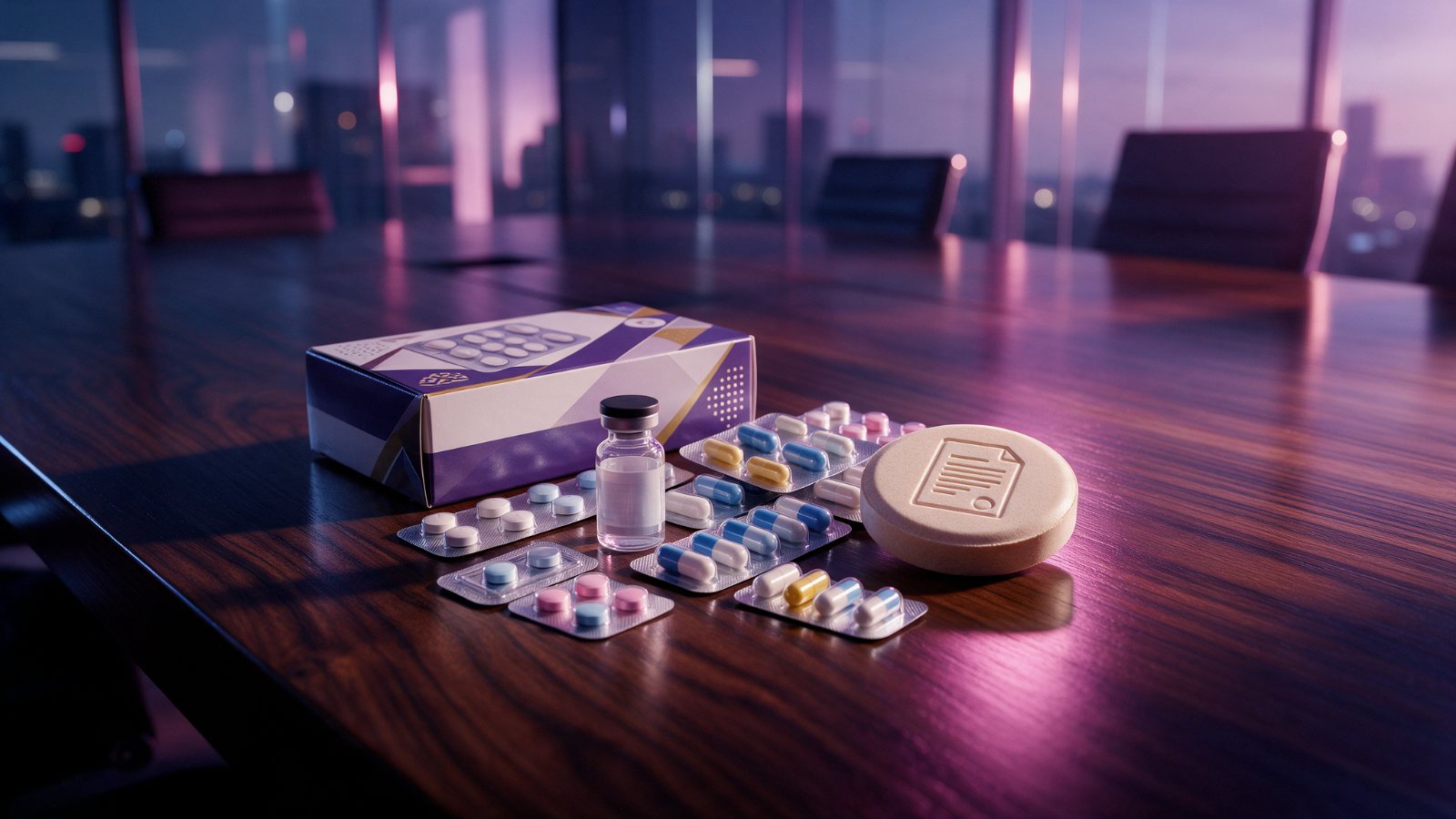
Out-licensing is how a pharmaceutical product reaches markets its owner will never enter directly. A company that has developed a dossier, or holds rights to a formulation, grants another company the right to register and commercialise it in a defined territory. Done well, it turns a static asset into recurring revenue. Done carelessly, it creates a dossier stuck in a market where nobody is pushing it.
This is how the process usually works, step by step, and where it tends to break.
What is actually being licensed
The first clarification is the object of the agreement. It may be the dossier only, the dossier plus supply of the finished product, or the right to manufacture locally under technology transfer. These three scenarios carry different economics and different obligations, and confusing them at the start produces disagreement later.
In most partnerships involving finished dosage forms, the structure is dossier plus supply: the licensor provides the registration documentation and manufactures the product, the licensee registers it in its territory and handles commercialisation.
The territory and the exclusivity question
Territory is defined by country, not by region, because registration is national. Exclusivity is the point that deserves the most attention: a licensee investing in registration and market access will normally ask for it, and a licensor granting it loses every alternative in that country for the duration.
The usual compromise is exclusivity tied to performance. Minimum annual volumes, a registration deadline, a launch deadline. If the milestones are not met, exclusivity converts to non-exclusive or the rights revert. Without those clauses, exclusivity is a blank cheque.
The documentation phase
Before any commitment, the licensee assesses whether the dossier can realistically be registered in the target country. This normally includes:
- the format and completeness of the dossier against local requirements
- the regulatory route for the active ingredient and its validity in that market
- stability data covering the relevant climatic zone
- the GMP status of the manufacturing site and its acceptability to the local authority
- labelling, packaging and language requirements
- whether comparable products are already registered, and under what conditions
Climatic zone is the item most frequently underestimated. A dossier with stability data generated for a temperate zone may require additional studies before it can be submitted in a hot and humid market, which changes both the timeline and the budget.
Commercial terms that hold up
Out-licensing agreements are usually built from a combination of an upfront payment, milestone payments tied to registration and launch, and a transfer price for supply. The balance between these components says a lot about how the risk is shared: a high upfront with a low transfer price shifts risk to the licensee, the opposite shifts it to the licensor.
Two clauses repay the attention they require: what happens to the registration if the agreement ends, and who owns the marketing authorisation in the territory. Both are simple to agree at the beginning and very difficult to negotiate once the relationship has deteriorated.
What makes a partnership work after signature
The agreement is the beginning of the relationship, not its conclusion. The projects that work share three habits: regular forecasting so that production is planned rather than improvised, a defined channel for regulatory questions from the authority, and early notification of any change at the manufacturing site.
The projects that fail usually fail quietly: a registration that is never submitted, forecasts that never arrive, a product that stays in the portfolio without ever reaching a patient.
Where to start
Synergy Swiss Pharma works with international licensing and distribution partners and is currently open to out-licensing opportunities across several therapeutic areas, including aesthetic dermatology and regenerative skincare, longevity and healthy ageing, women’s health, advanced nutraceuticals and dermatological photoprotection.
Companies looking for a manufacturing partner rather than a licence can work through Synergy Swiss Business Development, while facility and plant projects are handled by Synergy Swiss Engineering. Practical questions on documentation and markets are covered in the FAQ section.
Related reading
- CEP, DMF or ASMF: which regulatory route for which market — how the three dossier routes differ and which one your destination market actually accepts
- Why source pharmaceutical products through Switzerland — what a Swiss intermediary adds between a manufacturing site and a destination market
- Nutraceuticals vs medicines: what actually changes — different rules, different claims, different registration paths for the same production site
Looking for products to license in your market?